A Jimmy Heath Centennial Tribute
Musings on the great Philly-born tenor saxophonist, longtime Queens resident and erstwhile proponent of witty wordplay who would’ve turned 100 today

In the flood of major figures having centennials this year (Miles Davis, John Coltrane, Tony Bennett, Randy Weston, Ray Brown, Oscar Peterson), Jimmy Heath sometimes gets overlooked. The great Philadelphia-born tenor saxophonist-composer (“Gingerbread Boy” and “C.T.A.,” among 100 others), arranger-bandleader-educator and jovial jazz icon would’ve turned 100 on October 25th. Jimmy inherited a sharp wit and quick sense of humor from his mother, according to Sonny Rollins. And while he may have been small of stature (his 5-foot-3 frame earned him the nickname “Little Bird”), he stood as a giant in the jazz world for seven decades.
A 2003 NEA Jazz Master, Heath was raised on the South Side of Philadelphia with older brother Percy (who later took up bass after a stint in the military during WWII) and younger brother Albert “Tootie” (who eventually became drummer in The Heath Brothers, the band they formed in 1975). In high school, Jimmy played alto sax in local Philly dance bands before hitting the road in 1945 with Nat Towles’ band. In 1946, he was often jamming and woodshedding with fellow Philly saxophonist John Coltrane, who had just returned home from a stint in the Navy, and fellow saxophonist Benny Golson in the Heath family home at 1927 Federal Street in the Point Breeze neighborhood of South Philadelphia. Later that year, Heath formed a 17-piece band that included Coltrane, Golson, Ray Bryant, Nelson Boyd and Johnny Coles.
Following his tenure in Howard McGhee’s band in 1948, Jimmy joined Dizzy Gillespie‘s big band (along with Coltrane) from 1949-50. As he later said of the ebullient trumpeter-bandleader’s profound influence on him, “Dizzy Gillespie is my Duke Ellington.”

In the early 1950s, Heath switched to tenor sax (heavily influenced by Dexter Gordon’s big tenor sound) and began playing with Miles Davis in 1953. With brother Percy on bass, they recorded six tunes together with Miles (including Jimmy’s “C.T.A.”) at WOR Studios in New York City on April 20, 1953. Those sessions were released later that year on Blue Note as Vol. 2. Heath would later tour with Miles in 1959, the year that Kind of Blue came out. In the intervening years, between 1955 and 1959,
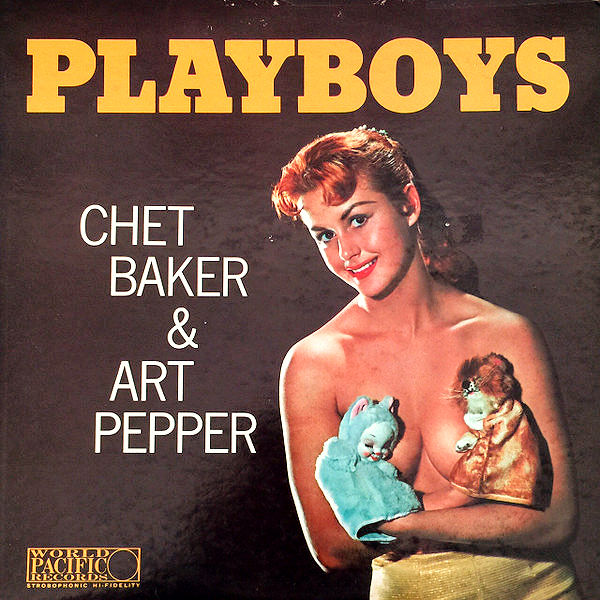
he served time in the federal penitentiary in Lewisburg, Pennsylvania after being arrested and convicted for the sale of heroin. He not only kicked the habit in Lewisburg, he remained active as a composer, penning five pieces for the 1956 Chet Baker-Art Pepper album, Playboys on World Pacific Records. Heath was released on May 21, 1959, and remained clean for the rest of his life.
By the 1960s, Jimmy started making his own recordings as a leader, beginning with 1961’s The Quota on Riverside (with bothers Percy and Albert on board, along with pianist Cedar Walton). That debut was followed by two more on the Riverside label — 1962’s Triple Threat and 1963’s adventurous Swamp Sweed featuring pianist Herbie Hancock, trumpeter,

Donald Byrd, tubaist Don Butterfield and French horn players Jim Buffington and Julius Watkins along with Percy Heath on bass and Albert Heath on drums. Jimmy worked frequently through the ‘60s with Art Farmer and Milt Jackson, among others, before forming The Heath Brothers band (with pianist Stanley Cowell) in 1975 and premiering with 1976’s Marchin’ On on the Strata-East label. They followed with a string of albums for Columbia Records — 1978’s Passin’ Thru…, 1979’s In Motion, 1980’s Live at the Public Theater and 1981’s Expressions of Life. Subsequent releases by The Heath Brothers included 1982’s Brotherly Love and 1984’s Brothers and Others (both on the Antilles label), followed by 1997’s As We Were Saying… and 1998’s Jazz Family (both on Concord Jazz)
Jimmy played multiple times with his big band through the 2000s, including two nights in 2011 that became Togetherness: Live at the Blue Note released in 2013 on the Jazz Legacy Productions label. And I recall one memorable performance that I caught at the Blue Note on March 9, 2016 and reviewed for Downbeat:
Jimmy Heath Stuns Audience with 90th Birthday Celebration at New York's Blue Note Nightclub
When saxophone legend Jimmy Heath appeared at the Blue Note in New York City on March 9 in celebration of his 90th birthday, it was hard to say which was better: his wonderful performance with a 17-piece big band on stage or his equally compelling warmup behind the scenes.
The man is a walking encyclopedia of jazz history (well documented in his excellent 2010 autobiography, I Walked With Giants), and his memory is still tack-sharp. So those gathered backstage got to hear tales of how Johnny Hodges and Ben Webster used to quiz a young Heath on the lyrics to various jazz standards, of playing alongside John Coltrane in Dizzy Gillespie’s big band (“After the gig, all the chicks would walk right past me and Trane and go right for Paul Gonzalves, because he was so damn handsome!”) and of sharing the stage with the likes of Coleman Hawkins and Charlie Parker. This was just an appetizer before the banquet of music Heath laid out with his dynamic big band.
An ebullient presence on stage, Heath is an animated conductor who likes to move around, clap along and shout encouragements to his soloists. On this night he led his young charges on material from his last two big band outings—2013’s Togetherness, which was recorded live at the Blue Note, and 2006’s Turn Up The Heath.
The punchy set-opener, “Togetherness,” was highlighted by some show-stopping high-note trumpet pyrotechnics from Freddie Hendrix (Heath’s Cat Anderson in this aggregation) along with stellar solos from alto saxophonist Mark Gross, tenor saxophonist Bobby LaVell, trombonist James Burton and pianist Michael Weiss. The band’s fiery 22-year-old drummer, Evan Sherman, fueled this swinging chart with his crisp, insistent beat and fierce attack on the kit. As the elder statesman said of Sherman to the audience, “I’m honored to have this young man join the old man to make something original.”
Heath’s compositions and arrangements are original indeed. And while this one-time professor of music at the Aaron Copland School of Music at Queens College has an obvious flair for counterpoint and harmony, the essence of his music is the swing factor, which ties him indelibly to all those jazz giants he spoke so fondly of before the set.
On his composition “Sleeves,” his clever contrafact on the standard “Autumn Leaves,” Heath played his tenor sax with remarkable fluidity and a robust tone, nonchalantly dropping in a quote from “Fascinating Rhythm” in the middle of his solo. Trumpeter Greg Gisbert also offered a blistering solo on this inventive number. Heath’s “A Sassy Samba,” dedicated to Sarah Vaughan, had tenor saxophonist LaVell deep in a Getzian mode and also featured Argentine trumpeter Diego Urcola, a former student of Heath’s at Queens College, on a beautiful Latin-tinged solo.
The intricate, midtempo swinger “Sources Say,” Heath’s jab at the way the press often reports rumors without naming names, featured outstanding solos by trumpeter Hendrix and baritone sax ace Gary Smulyan. Heath was again featured on tenor for a lush reading of the Jimmy Dorsey ballad “I’m Glad There Is You,” which was easily the emotional highpoint of the set. Following Heath’s elegant, lyrical solo leading into a virtuosic cadenza, there was a collective sigh in the room from audience and band members alike—all seeming to sense that they were witnessing something profoundly rare.
Heath’s hip jazz waltz “Gemini,” written decades ago for his daughter, showcased tenor saxophonist Mike Lee digging deep in bold, hard-boppish mode and also featured a brilliant flute solo by LaVell that had him playfully quoting from “All Blues.” They closed the set in dramatic fashion with the Latin-flavored Gillespie tribute number “Without You, No Me,” which featured crackling solos from Gisbert and the bandleader himself. Following that explosive closer, Heath was back upstairs to reminisce again, right up until it was time to start the second set.
Heath died in on Jan. 19, 2020 at age 93. His posthumous Love Letter, released on July 17, 2020, was a beautiful ballads album that I gave five stars in Absolute Sound:
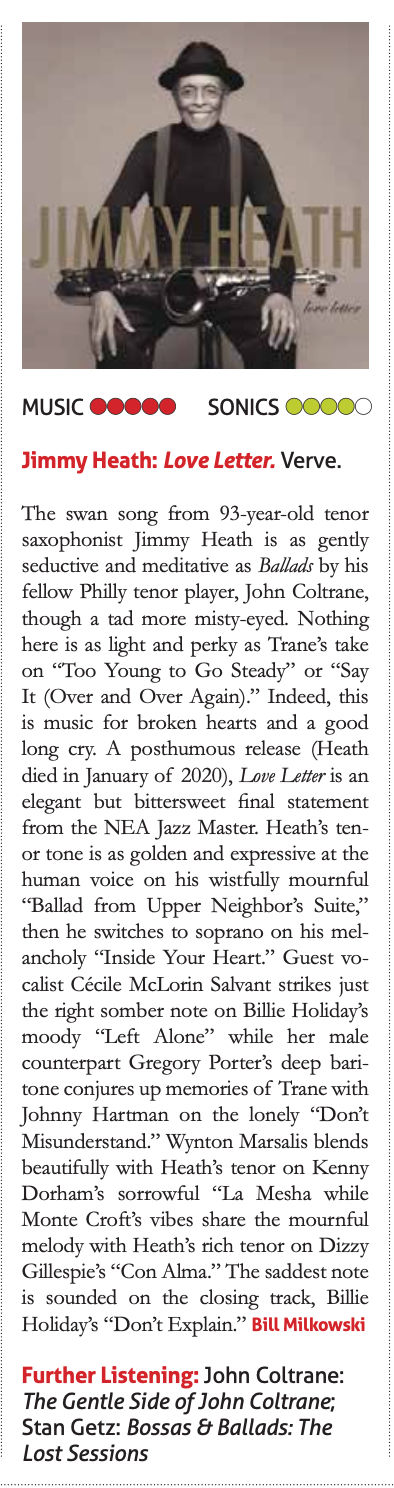
Just the other day, in the middle of the afternoon, I started thinking about Jimmy Heath, and a big smile crept across my face. I was remembering the time at the 2007 International Association of Jazz Educators convention (the organization folded in 2008, supplanted by the Jazz Educators Network, which has been holding annual conventions in Reno, Dallas, New Orleans ever since) when I happened to be standing directly behind Mr. Heath as he was checking out one of the college bands performing at the conference that year. Jimmy stood there in rapt attention, stroking his goatee with an impish grin as he checked out the band just a few feet in front of him. And then he said to no one in particular and yet everyone within earshot, his voice dripping in sarcasm: “Huh! Interesting! Jazz that doesn’t swing!!”
Heath had an impish, wickedly witty quality about him. Plus, a passion for puns. Some of Heath’s pronouncements on mic while introducing the names of tunes or members of the band involved some clever wordplay. Just check out his rhyming pun-based monickers, all a part of Jimmy’s ongoing “name game,” listed in the Appendix to I Walked With Giants :
“Foster’s Frostings” (his description for Frank Foster’s distinctive, sweet and layered big band arrangements); “D-Maculate Perception” (nickname for drummer Dennis Mackrel); “Jug’s Hugs” (nickname for tenor player Gene “Jug” Ammons); “Wayne’s Terrain” (his description of the musical style of close friend Wayne Shorter); “Faddisphere” (for high-note trumpeter Jon Faddis); “Charmer Farmer” (for trumpeter Art Farmer); “The Metal Melter” (vibraphonist Milt Jackson); “Why-not Cliff” (trombonist Wycliffe Gordon); “Powell to the People” (trombonist Benny Powell); “Brainy Brownie” (trumpeter Clifford Brown); “Roy Hardgroove” (trumpeter Roy Hargrove); “Payton’s Pace” (trumpeter Nicholas Payton); “Styles Davis” (trumpeter Wallace Roney); “Owens Knowin’s” (trumpeter Jimmy Owens); “Strolloff” (trumpeter Lew Soloff); “Staff Inflections” (trumpeter Terrell Stafford); “Invincible” (alto saxophonist Vincent Herring); “Scary Smulyan” (bari sax ace Gary Smulyan); “Riffin’ Griffin” (tenor saxophonist Johnny Griffin); “All Hart” (alto saxophonist Antonio Hart); “Chew Tobacco” (tenor saxophonist Lew Tabackin); “Haynes Reigns” (drummer Roy Haynes); “The Riddler” (bassist Larry Ridley); “Tall Mess” (bassist Paul West); “Veal Chops” (bassist Reginald Veal); “Geoff Pleaser” (pianist Geoff Keezer); “The Onliest” (Thelonious Monk); “Joe Fifth Avenue” (Josef Zawinul); “Oscar Speedyson” (Oscar Peterson), “Herbie Handscapes” (Herbie Hancock); “Benny Mean” (Benny Green); “One Alone” (Russell Malone); “Panama Dances” (Panama Francis); “Razor Blade” (Brian Blade); “Cobweb” (Jimmy Cobb); “Stroker” (Mickey Roker); “Lewish Bash” (Lewis Nash); “Duke Elegant” (Duke Ellington).
I remember that quality going back to the first time that I saw him in the late ‘70s with The Heath Brothers at The Jazz Gallery, an intimate and exceedingly hip venue in the middle of a working class Milwaukee neighborhood that has since undergone a renovation and yuppiefication and now goes by the name of River West.
I finally got to interview Jimmy Heath in person in 2011. He had just come out with Y and Jazz Times sent me out to his place in Flushing Queens (walkable to Louis Armstrong House Museum in the nearby Corona neighborhood) for my brush with a living legend. One thing I do remember during my two hour-long hang at Jimmy’s was that you could clearly see the Mets newly-constructed Citifield from his bathroom window. Here is that story from the April 2010 issue of Jazz Times:
Jimmy Heath: The Endless Search
Beloved by his bop-era colleagues as well as generations of disciples, veteran saxophonist-composer-age 83, the NEA Jazz Master (Class of ’03) is blowing potent lines on both tenor and soprano saxophones, as evidenced by two recordings from 2009: the Heath Brothers’ Endurance (JLP) with Albert “Tootie” Heath on drums, David Wong on bass and Jeb Patton on piano; and the Dizzy Gillespie All-Star Big Band’s live outing, I’m BeBoppin’ Too (Half Note).

Endurance was the first Heath Brothers project since the passing of brother and bassist Percy in May 2005. (As the saxophonist says, using humor to offset hard reality, “Two out of three ain’t bad!”) The album finds Jimmy in top form, bearing down with ]uent tenor lines on his buoyant opener “Changes” and on his urgent shuffle-swing number “Wall to Wall,” ]aunting robust tenor tones on the poignant “Ballad From Leadership Suite,” and switching to soprano sax on Patton’s engaging “Dusk in the City.” He navigates the tricky head of “Two Tees” with ease before delivering a smoky, burnished sound on “Autumn in New York.” The diminutive (5-feet-3-inches) jazz giant concludes the set with a strong tenor performance on “The Rio Dawn,” his musical impression of his first visit to Brazil in 1982.
While clearly in full command of his instrument, Heath has also been showcasing his considerable writing-arranging and conducting skills with his celebrated big band-most recently documented on 2006’s Turn Up the Heath on Planet Arts. In this regard, he’s come full circle from his first leader experience in 1946, the Jimmy Heath Orchestra, which featured a very young John Coltrane on alto sax. “I still love big band,” he beams. “I was raised up with that sound. After Duke Ellington and people like that, how can you give that up? The only problem is transporting a big band because it’s so expensive. But there are still nuts out here like me, Maria Schneider, Slide Hampton, Jon Faddis, Frank Foster, the Vanguard Orchestra and some others who believe in the big band. This is our symphony orchestra. And from an arranger’s point of view, it’s so satisfying because we can get so many musical textures and sounds out of a big band with the pairing of instruments. It’s endless.”
Heath, in fact, wrote an extended piece for the Seattle Repertory Jazz Orchestra called “The Endless Search,” which premiered in 2006. “That’s what my life is about … the endless search,” he says. “As long as I’m here I’m gonna be trying something.”
One intriguing project on Heath’s horizon is a hip-hop-big-band experiment featuring his son Mtume and grandson. “We had a proposal that involved three generations of the Heath family,” he explains. “My grandson is going to come in with some beats and all that. You know, I don’t have blinders on, I’m still open to new sounds and ideas. My problem with a lot of today’s contemporary music is that in my day we were looking for artistic excellence and now they seem to be into narcissistic decadence. … But we just want to show that this blending of hip-hop and jazz can be done with taste.
Heath reveals the details of his life and illustrious career in his recently published memoir, I Walked With Giants: The Autobiography of Jimmy Heath (Temple University Press). Co-written by Joseph McLaren, a former ]ute student of Heath’s at the Jazzmobile during the early ’70s who is currently an author and professor of English at Hofstra University, this compelling 336-page book captures the essence of the bebop era from an insider’s view while retaining the saxophonist’s colorful storytelling style. From his first touring experiences with the Calvin Todd and Nat Towles orchestras to early gigs with the Howard McGhee Sextet and Gil Fuller’s band in the late ’40s, we see the young musician develop his own sound while dealing with dispiriting acts of segregation and racism on the road.

In Heath’s autobiography we read all about his stint with mentor Dizzy Gillespie in 1949-50, followed by a gala tour in 1952 with the Symphony Sid All-Stars. We follow Jimmy’s progress from his brief tenure with Miles Davis in 1959 (as a replacement for Coltrane) to his marriage to Mona Brown (they recently celebrated their 50th anniversary) and the eventual formation of the Grammy-nominated Heath Brothers band.
Through it all, the middle Heath brother (Percy was the elder sibling) spares no detail. Most gripping is Heath’s account of his heroin addiction and arrest for possession and sales, leading to his incarceration in 1955 at the Lewisburg Penitentiary in Pennsylvania. As he writes:
“They charged me as a second-time drug offender for drug sale. When I went before Judge Lord, I was told that each sale had two counts-selling, facilitating, and resale, so I had six counts. I got six years on each count, but the first five counts ran concurrently, so I had a six-year sentence.” He chronicles his kicking the heroin habit and organizing a prison big band while in jail, and explains how brother Tootie smuggled his new compositions out of prison and delivered them to Chet Baker, who included a few on his 1956 album Playboys.
In an interview at his home in Corona, Queens, where he and Mona have been living since 1964, Heath commented on those tumultuous times: “Yeah, Dizzy fired me and then he hired me back after I straightened my life out. Because I was a sick man, you know? That’s what it is. It’s a sickness that’s very difficult. But in retrospect, I think it was a blessing that I went away to get straight. I just thought four and a half years was too long, man. It definitely stifled my career, but it also saved my life. My career I could get back. My life … I got to have my life. And when I look back, a lot of my peers didn’t make it. Charlie Parker was only 34, man, and he was outta here! He left the world with a wealth of music, but he doesn’t get his life back. Coltrane died at 40. We were boys together in Philly, man! And so many others died young. So being in Lewisburg was a blessing in disguise. I learned from that never to do that again, and I didn’t.”
Upon being released from prison on May 21, 1959, Heath almost immediately began working regularly around Philadelphia with trumpet great Kenny Dorham. He also picked up a high-profile gig in June of that year at the Apollo Theater with the Gil Evans big band. Cannonball Adderley, who had championed Jimmy’s cause during his period of incarceration, recommended Heath to Orrin Keepnews, who quickly signed the saxophonist to Riverside after his release and presided over 1959’s The Thumper and 1960’s Really Big!
But even though he was out of prison, Heath was not entirely a free man. When he couldn’t make a gig in Chicago, a condition of Heath’s probation requiring him to remain within a 50-mile radius of Philadelphia ultimately foiled his chance to work with Miles Davis. As he writes, “I told my probation officer, ‘I got the best job I ever had in my life. I’m making a lot of money, five or six hundred dollars a week. You’re cutting me off from making my livelihood.’ And he said, ‘I can’t do anything about it.’ He had just given me permission without checking -- he blamed it on higher-ups in Washington, D.C. -- and now he found out that he shouldn’t have. Miles was very disappointed, but he had friends in Philly. He tried everybody he knew with authority in Philadelphia, but no luck. … Now I had a job, an opportunity to be with one off the best bands in the land and in the world, and I couldn’t go. I was being penalized for my past.”
Fifty years later, Heath’s many awards, trophies, citations, medals and plaques are piling up in his computer room, where he works on his big-band arrangements and extended compositions (using Finale software on his Mac). “Plaques? I got more plaques than people got on their teeth,” he jokes. On prominent display in this cluttered workroom is a large framed picture of Charlie Parker sitting as a guest soloist with Heath’s big band, circa 1946 (with a youthful John Coltrane in the horn section on alto).

As far as the state of jazz in the year 2010 and in the future, Heath remains hopeful. “There are some artists out here that are leading young players into something that doesn’t swing,” he says. “They think it’s hip to change up, but all changes are not good. You have to be careful about throwing away everything to get to something new. But I also know, from going around to schools like Queens College and Loyola in New Orleans and judging the Thelonious Monk Saxophone Competition, that there are some very good young players out there who are steeped in the tradition and ready to take the music forward.”
As for his own accomplishments over his lengthy career, Heath has never thought of himself as a star, a term he actually disdains. “I’ve always been one of the guys, and I like that,” he says. “To be respected by your peers, you can’t ask for anything better than that.”
Meanwhile, BCM+D Records, the label launched by Temple University’s Boyer College of Music and Dance in Philadelphia, recently announced the upcoming release of The Newest One, a live date from 2018 by the Jimmy Heath Big Band featuring bass trombonist Douglas Purviance and alto saxophonist Antonio Hart, both of whom worked with the Heath family to bring this posthumous recording fruition. “It warms my heart that people are finally going to be able to hear this music,” Purviance said. “Mister Heath’s music feels so good; it gets into your soul. It reminds me so much of his personality, because he was a great virtuoso on the saxophone, but the way he played was so from the heart and soulful.” Added Hart, “Doug and I wanted to give back for all the things that Master Heath has given us. We wanted to do our part to make sure that people continue to appreciate one of America’s greatest composers and one of the greatest composers and arrangers in the history of jazz. He was tuned in to the creator in terms of that love, that higher vibration, so when you hear his music or when you play his music, it just makes you feel good.”
The Newest One is scheduled for a November 20 release.


Comments