In Praise of the Hulking 300 lb Beast -- Part III
My audience with the legendary heavyweight champion of the Hammond B-3
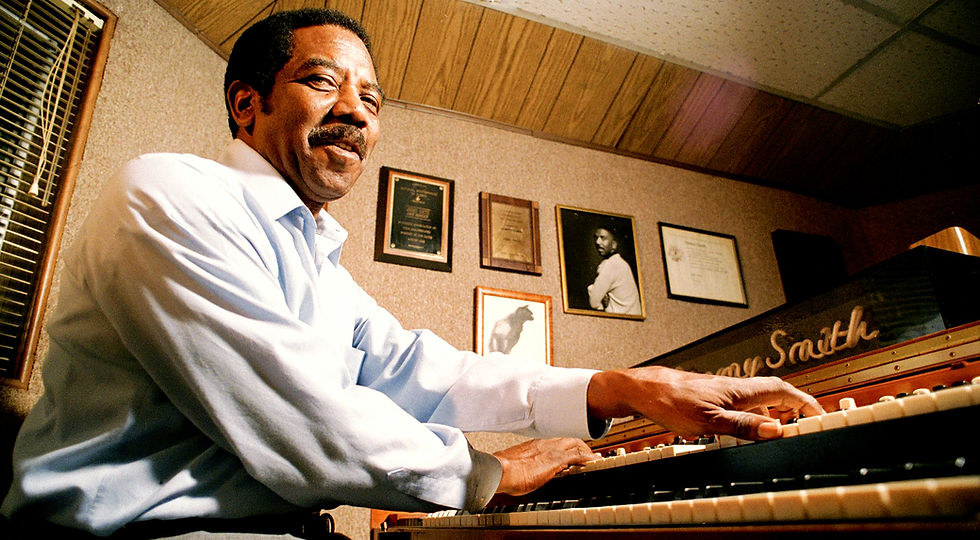
Continuing my appreciation of the majestic Hammond B-3 organ in its many manifestations, Part III and Part IV in this ongoing series focuses on two separate interviews conducted ten years apart with two legendary B-3 players — the undisputed heavyweight champion of the B-3, Jimmy Smith (for a February 1995 interview of Jazz Times), and Dr. Lonnie Smith (for a January 2005 issue of Jazz Times).
The Jimmy Smith interview was conducted by phone on Sept. 29 1994 — me from my home office in New Orleans, where I lived from July 1993 to November 1996, Jimmy at his home in Los Angeles. Jimmy’s wife Lola answered the phone when I called and she informed me that he was right in the middle of watching a cowboy movie on tv, a favorite pasttime of his. I hated to interrupt, but Jimmy got on the phone and seemed in a particularly good mood. That’s an understatement. He was wildly extroverted and in X-rated party humor mode, a la Rudy Ray Moore or Robin Harris. I remember thinking, “This cat should be doing standup comedy albums,” along the lines of Eddie Harris’ 1976 spoken word album, The Reason Why I’m Talking S—t!
Our conversation for the next half hour was freewheeling and hilarious, and after it was over I realized that I had maybe five or six minutes of useable material. He did talk about the development of his trademark Hammond B-3 organ style and his current recording at the time (Damn! on Verve), but the rest was a wild stream of consciousness monologue full of expletives. At the end of our chat, I mentioned to Jimmy that I had just polished off a catfish dinner at my favorite New Orleans restaurant, Uglesich’s, a legendary place on Baronne Street in Central City that Croatian immigrant Sam Uglesich had opened back in 1924 and was currently being run by his son Anthony. “Catfish? Ooooh, you dirty dog!” Smith moaned with envy. When I went on to describe the specifics of the dish —chef Anthony’s popular Muddy Waters catfish topped with jalapeno peppers and garlic —Jimmy made an unusual proposition: “I’ll tell you what...next time I come to New Orleans, I think I might suck your dick if you treat me to some catfish.” Unfortunately, I moved from New Orleans the following year and never had the opportunity to follow up on Jimmy’s generous offer. Here’s that Jazz Times piece from 1995:

He is now and has been for the past four decades the king of the hill, the baddest of the bad, the undisputed heavyweight champion of the Hammond B-3 organ. When Jimmy Smith jumps on an uptempo groove and lets his right hand fly or when he digs deep into a greasy blues with real-deal intensity, practitioners and connoisseurs alike can only sit back in utter amazement, shake their heads in disbelief and mutter...Damn!
An all-out blowing session, Damn! confirms Jimmy Smith’s status in the B-3 world; still the organist that everyone is chasing. For this fiery session, Smith’s inimitable B-3 burn is highlighted alongside some of the hottest young horn players on the scene today. Challenged by Young Lions like guitarist Mark Whitfield, trumpeters Roy Hargrove and Nicholas Payton, saxophonists Tim Warfield, Mark Turner, Ron Blake and Abraham Burton, Jimmy rises to the occasion and wails with abandon. Teeming with energy, Damn! harkens back to Jimmy’s landmark recordings from 38 years ago with a young Kenny Burrell, Lou Donaldson, Hank Mobley and Donald Byrd (recently compiled and released by Mosaic Records as a three-cd boxed set entitled The Complete February 1957 Jimmy Smith Blue Note Sessions). That same no-holds-barred intensity prevails on Damn!
From funky throwdowns like James Brown’s “Papa’s Got A Brand New Bag,” Horace Silver’s “Sister Sadie” and Herbie Hancock’s “Watermelon Man” to scorching bop anthems like Dizzy Gillespie’s “Woody ‘N’ You” and Charlie Parker’s “Scrapple From The Apple,” the entire session is marked by scintillating interplay. Anchored by bassist Christian McBride and drummers Bernard Purdie and Arthur Taylor (in his last recorded performance), Jimmy drives the session from behind his hulking B-3 like a seasoned quarterback taking his team downfield for a last minute touchdown in the Super Bowl. Simply put, the sparks fly on Damn!
James Oscar Smith was born on December 8, 1928 in Norristown, Pennsylvania. Both of his parents were pianists and his father was Jimmy’s primary teacher. At the age of nine, he won first place in a Major Bowes Amateur Hour contest playing boogie woogie piano. At the age of 12, he teamed with his father in a song and dance act, performing at various clubs and on radio shows in and around Philadelphia. Following a stint in the Navy, he used the GI bill to attend Ornstein’s School of Music, where he studied bass and piano. It was in 1951, while playing in Don Gardner’s Sonotones, that he became interested in organ. Soon after acquiring a Hammond B-3 organ, he went into a self-imposed period of intensive woodshedding that lasted nearly a year.
Since the release of his 1956 Blue Note debut, A New Sound...A New Star...Jimmy Smith At The Organ, Vol. 1, few organists have received as much attention. A perennial poll winner since the late ‘50s, Smith redefined the cumbersome instrument while opening a new door in the process for generations of players to come. As the late Leonard Feather wrote in his Encyclopedia Of Jazz: “The first attempt to bring the organ into the orbit of contemporary jazz was undertaken by Jimmy Smith, an extraordinary musician who makes fuller use than other jazz organists of the variety of stops at his dispoal. Smith plays fast tempo jazz improvisations in a style that would have blended perfectly with Charlie Parker’s combo, had Smith risen to prominence during Parker’s lifetime.” In a word…Damn!
With swagger and sass, Jimmy took the cumbersome 300-pound instrument to a new level beyond where B-3 pioneers like Milt Buckner, Bill Doggett and Wild Bill Davis had gone before him. Smith’s new sound utilized the first three draw bars and the percussion feature of the Hammond B-3. He also cut the tremelo off and began playing fluid horn-like lines with his right hand, inspired by players like Coleman Hawkins, Don Byas and Arnett Cobb. As he once explained, “I copped my solos from horn players. I don’t listen to keyboard players. I can’t get what I want from keyboard players,” although he also admits that Bud Powell, Art Tatum and Erroll Garner were important influences.
Jimmy, in turn, has influenced generations of musicians. His inspiration has been acknowledged by countless other organists including Brother Jack McDuff, Jimmy McGriff, Booker T, Billy Preston, Larry Young, Lonnie Smith, Richard Groove Holmes, Georgie Fame, Joey DeFrancesco, Barbara Dennerlein and John Medeski. His continuing influence is reflected in today’s acid jazz scene via sampling by groups like the hugely popular Us3, who regard Jimmy Smith as the godfather of soul-jazz.
Perhaps Clive Davis of The London Times put it best when he wrote: “Smith continues to extract an awesome degree of power from his keyboard. The slick walking bass lines laid down by the pedals and the cluster bomb explosions of blue notes from his right hand have been copied by admirers across the generations. His ability to build to a dramatic gospel climax remains undiminished.” That testimony rings true on Damn!
You recently opened for Horace Silver at the New Orleans Jazz & Heritage Festival. Later Horace was overheard saying, “I’m not gonna let anybody ever book me to follow that crazy Jimmy Smith.
Yeah, I heard that. “He didn’t even leave a piece of stage for me to play on. He burned the place down!” I didn’t even know what I was doing. I was under a spell—my mojo spell. You know anything about voodoo? I spread some mojo dust all around the bandstand before I go on. Then I spread just a teeny bit around my organ and I let my tenor player step on just a little bit of the powder. That’s to keep his ass hot. And that’s how come he burns so much. When he plays, he plays! The rest of the stuff, the aroma just goes all over the bandstand.
So you got your mojo woikin’.
I gotta keep it woikin’!
Did you do the same thing down in Osaka when you made that live record last year (The Master II) with Kenny Burrell?
Hey man, we had it working there, too. And the drummer Jimmie Smith—I had to spread a little bit around the drums ‘cause he sound scared of me. He never played with me in his life. He played with Jimmy McGriff but he never played with me. And he told me, “It’s altogether different when you’re playing with Jimmy Smith. Everything—all my life has changed.” He said, “Jimmy Smith will rejuvenate you, change your stuff around.” ‘Cause I had to teach him how to play with me. A drummer can’t just jump up and play with me, not just any drummer. ‘Cause I’ll lose him. Oh man, he’ll get lost in the shuffle…dropping sticks and everything.
And that mojo dust works?
Hey, motherfucker, if I come down there to New Orleans again to play, I’ll put a spell on you. You won’t know your way home. You be driving on the wrong street somewhere.... “Damn, I thought this was Rampart!”
That live in Osaksa album is great. Sounds like you were all in a good mood that night, playing some blues in Japan on the night before Christmas.
Oh man, we had champagne and Kentucky Colonel chicken. Yeah, we had the Colonel in Osaka, man! That’s the day we went on top of the Hilton, the penthouse. Man, they had a nice buffet up there. Kenny took his bear with him and I had my wolf with me.... Uh, well, Lola’s a lion.
Your wife Lola says all you wanna do is eat and look at the cowboy movies.
That’s right.
And never gain a pound.
You got that right. And I’m almost 66 years old, you know.
It’s great to hear you still playing with Kenny Burrell after all these years.
And he don’t look too old either. He’s getting gray but the face is still young.

Elvin Jones is another guy who looks eternally youthful.
No, well, Elvin’s too ugly to look old. That’s an ugly man. You know what happened? When we first met it was Haight-Ashbury in Frisco, and man...I was off on Monday, I was playing at the Jazz Workshop and he was playing at the Blackhawk. So anyway, I wasn’t working on this Monday and he was on. So I walk in the door to catch Elvin’s gig and the guy at the door says, “Jimmy Smith, come on in! Elvin Jones is here, man. I hope you guys can hook up tonight, man.” And here comes Elvin, “Hey, man, we’re gonna get into something tonight, OK?” I said, “What? I ain’t never played witchyou, man.” So he just grabbed me, and he’s strong anyway...I had to put all my little karate shit on his ass. I grabbed his dick. He say, “Turn my dick loose, motherfucker.” I say, “Man, don’t fool with me, boy!” Everybody say, “Jimmy Smith is crazy, don’t fool with him.” ‘Specially when I’m not playing...And I’m “off,” I’m really off. It’s what the black people call you. It’s not o-f-f, it’s o-a-f. They say, “The nigger’s oaf.” That’s from the South. Say that. It sounds good. It’s got a ring to it. So anyway, we play. Elvin broke the sock cymbal right off, man. He done broke that sucker, ‘cause he’s so strong, man. And when we got done, I was soaked, he was soaked, our socks were wet. I’m serious, Bill. Our socks were soaking wet! I messed that suit up—you know, all that salt you get from sweating. You ever see a musician with those white armpits? These motherfuckers with all that salt beadin’ their ass up?
Just like a race horse?
Exactly.
I just got this new Mosaic box in the mail.
The what?
Mosaic Records just put out that boxed set of your stuff from 1957.
I never heard of Mosaic Records.
They compiled all your Blue Note recordings from three days in February 1957.
Oh man, I don’t know about that. It’s probably sitting back there unopened with a bunch of other records I ain’t never had time to get to.
You don’t listen much to music at home?
Nope. But do you know I’m doing a rap thing with the Plus Three?
Plus Three?
We Three?
You mean Us3?
Well, somebody’s damn Three!
Yeah, it’s Us3. Or as they say down here, Y’all Three.
[Laughter] Yeah, goddamn! You got that sucker on the head, boy! Y’all Three. Whatever the fuck they are. Well, you heard about the three little monkeys, right? Hear nothin’, see nothin’, fuck nothin’... that’s them! But we played together over in London. Man, them kids was going crazy! I mean, I never heard young people holler so loud. It’s not like when the girls used to holler for Frank Sinatra, right? It’s not that kind of holler. This is like a violent, exciting, stomping their feet kind of holler. We did four nights, had 600 people every night in this small club. They just jammed ‘em in. And the only thing about it, buddy...my wife got a contact high. They had some reefer, some hash....I mean, smokin’ in the club! My wite came past them going up to the soundboard so she could hear what it sound like, you know. And by the time she got to the dressing room she be sayin”, “Whoooo! Jimmy-Jimmy-Jimmy-Jimmy! What are they smokin’ out there?” And I say, “Oh shit!” And I stepped out the dressing room door and the shit hits you right there. And she came all the way through that whole crowd that was smoking reefer. Man, she stayed in that dressing room the rest of the four nights. She didn’t move nowhere. She was really high. And her eyes was all funny looking and shit. Man, that was a wild gig. Of course, I also played Carnegie Hall this year. Did you see me on there, Bill?
I was there (Verve Records’ 40th anniversary celebration]. Yeah, that was a great show.
Why didn’t you come back and say something?
They had such a tight security thing happening it was hard to get backstage.
It was, it was terrible. They were putting all the managers out. They actually were gonna put Lola out until one of the fellas said, “You gonna put Lola out, then Jimmy’s not gonna play.” And the other fella said to Lola, “No, no, no, I better let you inside because I understand Jimmy has a temper.”
So tell me about Babs Gonzalez?
That nut! That damn nut! Oh, Bill, man...Did you know him?
No, but I loved his records.
Yeah, but damn, man, he was a nut! I met him in 1957. We were in the studio at 70 Broadway with [Blue Note founders] Alfred Lion and Francis Wolff. I had Eddie McFadden on guitar and Donald Bailey on drums. And, you know Babs, he lets everybody know when he’s making his grand entrance. He used to wear a cape. He was like Batman and shit. Ask anybody about Babs Gonzalez. He wore a cape and all that kind of shit. And he thought he was gonna be my manager. He was telling people he had discovered me but I was discovered already. Blue Note had came down to Philadelphia and they heard me play there. Babs said he brought them down, you know, like he’s my manager. So I had to deck this motherfucker, man. Did you know about his red pepper he’d throw in your eyes? Oh shit, he’d keep that in his lapel pocket. He wouldn’t fight. He couldn’t fight. He’d just throw pepper in your eyes, then he’d whup yo’ ass. So this man…He say, “I’m your manager, motherfucker!” And he put that forceful voice shit on. And I say, “Oh no you not!” And you know, I been in the Golden Gloves since I been seven years old. In Philadelphia you got to be able to pug. You don’t pug, you get your ass kicked too much. So I pugged my ass over. I was knockin’ suckers out that were damn near 195 pounds when I was in the Golden Gloves. You know what I mean? I decked them suckers, man. And when I hit Babs, he laid out so pretty like he was going to a funeral or something. I hit that motherfucker so hard. See, I forgot ‘cause I lost my temper. But he went out so nice, laid right on the floor, and Alfred Lion is running around screaming, “Oh my god, Jimmy’s killed the man!” Frank Wolff be coming around with his camera and everything. It was chaos in that fucking studio.
I know you got into some kind of karate.
Yeah, for 25 years now.
I’ve seen your album Respect (Verve, 1967), where you got your kung fu robe on the cover.
Not kung fu, motherfucker. That’s shotokan! And that means sho-kill-yo-ass. Yeah, I studied that particular method. Shotokan is when you go to the diaphragm and pull out the fucking food, show him what he ate for dinner, you understand? And I mean that shit! Go in there, pull them fuckin’ greens out, put ‘em right in the guy’s face and watch him faint. You know what I mean?
Yeah, that would come in handy on the subway.
Hey man, shit, you don’t need no damn gun. Pull them fucking intestines out—and they be movin, you know, like worms. That shit be running all over my damn hand.
OK... Switching topics here, how about telling us something about your early development on the organ.
Well, I wanted to learn fast, you see. I’m self-taught, you know. I left my organ in the warehouse where I supposed to pick it up and take it home. But I didn’t want people to know I couldn’t play that sumbitch. ‘Cause I couldn’t play it at first. So I left it in the warehouse and then...incidentally, the warehouse that I left it in, my daddy had plastered this particular warehouse. I’m a plasterer by trade. My dad taught us, me and my brother. So it was right on time. My daddy was nicknamed Mr. Blue Jimmy. Anyway, I asked if I could store my organ in this little room and practice, and the warehouse guy said, “Do anything you want.” So I stayed in that warehouse a year. I’d take my lunch, I’d take three sandwiches. And what I did, I had a guy make me a chart on the wall of the pedals, so I would look at that chart instead of looking down at the pedals to see where you was putting your foot. You look at the chart—that’s how I taught myself from the chart so I wouldn’t have to look down. You can’t be looking down at the damn pedals on a gig. You wanna get the people’s attention. So I taught myself my damn steps and I had to find my own sound. I kept pulling out stops until I lucked up on these three damn flute things. Then I cut my tremelo off to give it a big sound, and that sounded good. And that’s where I got my sound. ‘Cause I can put my tremelo to fast or medium or whatever to get the sound you want, see? So when I came out that fuckin’ warehouse, man, I was ready for anybody!

So you still play the same type of instrument?
Yeah, same one, Hammond. Forty years and those motherfuckers never gave me one. They never gave me shit. I’m still mad at ‘em. So anyway, I stayed in the warehouse for about a year — got a down payment from a loan shark, Mr. Goldstein. And he told me, “Now Little Sonny, I’m gonna have a man collecting every Saturday night.” And man, this motherfucker Bob would come in to the club—he’d be half tanked anyway — and he always carried that damn piece with him because if you didn’t pay, he’d blow your ass away. So I made sure I had that motherfucker’s money, you know? Hey man, I paid for my organ. Anyway, I got to playing some blues one night and people be shouting…you know how black people holler, like they in church! Piercing sound—it hits you. Well, Bob was getting into it. He had been drinking and he got excited and puts up his hands in the air and yells out, “Yeah!” And his piece falls on the floor. Somebody shouts, “Man got a gun! Lord have mercy, man got a gun!” Cleared the fuckin’ bar! And you know how black people are…they can move, boy! Now there’s a spiral stairway in this club. Can you imagine a bunch of black folks trying to get up a spiral stairway—crawling all over each other, ladies got their dresses up, their bloomers showin’ and shit…and I’m lookin’. It’s hard to get past somebody on a spiral stairway, but niggas can tiptoe past each other, man, doin’ ‘bout a hundred mile an hour. Man, with a gun? You kiddin’? They were flying up that damn staircase like a black Batman or something. And the poor little Jewish club owner comes out in the middle of all this...“Vat iz goink on? Ver de people go? Vat gun? Ver iz de gun? Whooz got de gun?”
Sounds like a scene from a movie.
Yeah, man. We had some fun back in the day. Still do.
NEXT: MY AUDIENCE WITH DR. LONNIE SMITH (AKA THE TURBANATOR)


Comments