In Praise of the Hulking 300 lb. Beast -- Part V
- Bill Milkowski
- 2 days ago
- 4 min read
A rundown of some renowned Hammond B-3 pioneers and two brilliant renegades

Wild Bill Davis is often credited as being “the father of jazz organ” for his pioneering work in the early 1950s, after having put in time (1945-1949) on the piano with Louis Jordan’s popular Tympany Five, appearing on such proto-rock/boogie woogie hits as “Choo-Choo Ch’Boogie,” “Saturday Night Fish Fry” and “Ain’t That Just Like a Woman.” Davis switched to organ in 1950 and made his recording debut as a leader in 1953 with Here’s “Wild” Bill Davis on Epic Records (accompanied by guitarist Floyd Smith and drummer Chris Columbus, his former bandmate in Jordan’s Tympany Five). He followed with two other Epic releases — 1954’s On the Loose and 1955’s At Birdland, both featuring Smith on guitar and Columbus on drums — before jumping to the Long Island-based Everest Records in the late 1950s.
And Davis scored something of a hit in 1958 with his two-part version of “The Madison Time,” released during the height of the Madison line dance craze. (Note him calling out the names of Wilt Chamberlain and Jackie Gleason on Part I).
Of course, both Fats Waller and Count Basie had already explored the organ in various recordings during the late 1930s. Here’s two from 1939 by Basie’s Bad Boys:
Fats Waller did also a series of delightful Hammond organ recordings from 1939 to 1943,
including these gems:
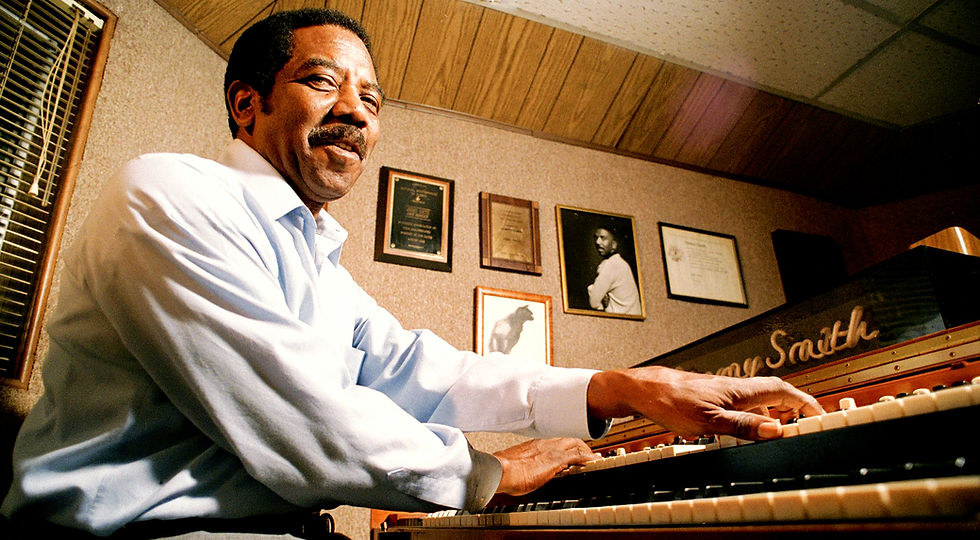
By the time Jimmy Smith (featured in Part III of this series) came along in 1956 with his bop-fueled B-3 bravado on the two-volume A New Sound…A New Star for Blue Note, the face of the Hammond organ was changed forever. And generations of players followed his soul-jazz example, from Jimmy McGriff, Jack McDuff, Charles Earland and Dr. Lonnie Smith to contemporary practitioners like Larry Goldings, Joey DeFrancesco, Mike LeDonne, Tony Monaco, Akiko Tsuruga, Sam Yahel, Pat Bianchi, Kyle Koehler, Jared Gold and Brian Charette.
But there were also those renegade organists who found their own ways on the instrument. Perhaps first and chief among them was Larry Young, who took the hulking 300 lb. beast into more modal and avant garde realms, first with Tony Williams Lifetime in the early and later as a leader in his own right. Often called the Coltrane of the organ,” the Newark, New Jersey native apprenticed with alto sax great Lou Donaldson before working around New York throug the ‘50s with trumpeter Kenny Dorham and saxophonists Hank Mobley, Jimmy Forrest and Tommy Turrentine. He debuted as a leader in 1960 with Testifying on the Prestige label, then quickly followed with Young Blues and Groove Street before jumping to the Blue Note label and releasing a string of forward-thinking albums beginning with 1965’s Into Something (with saxophonist Sam Rivers, guitarist Grant Green and drummer Elvin Jones) and continuing with his 1966 masterpiece, Unity (with trumpeter Woody Shaw, saxophonist Joe Henderson and drummer Jones).
He embraced a funkier muse on 1968’s Heaven on Earth (featuring George Benson on guitar) then dove headlong into fusion with Tony Williams Lifetime (featuring guitarist John McLaughlin), appearing on the group’s audacious debut in 1969, Emergency! , which absolutely startled the jazz establishment with its sheer raw power.
A week before Emergency! was released, in September of 1969, Young also appeared on Miles Davis’ pivotal Bitches Brew, which was released on March 30, 1970 and basically lit the fuse for the explosive fusion movement that followed in its wake. Young delved further into fusion and psychedelia on subsequent outings like 1973’s Lawrence of Newark, 1975’s Fuel, 1976’s Spacebar and 1977’s The Magician. His final recording was the adventurous Double Exposure, a provocative duo collaboration with drummer/percussionist/pianist Joe Chambers. Recorded on November 16, 1977, it was released posthumously on the Muse label in 1978, several months after Young’s passing on March 30, 1978 at age 37. The album was recently remastered for a vinyl reissue on Zev Feldman’s Time Traveler Recordings.
A bevy of brilliant B-3 players followed Larry Young’s renegade example by following their own muse, often with unorthodox and decidedly non-greasy results. Perhaps at the top of that list is John Medeski, whose wild experimentation on the Hammond B-3 organ with Medeski, Martin & Wood has been well documented since the group’s formation in 1991. With Chris Wood on bass, Billy Martin on drums and Medeski on a bank of analog keyboards (piano, clavinet and mellotron along with the trusty Hammond B-3 organ), MMW put a new slant on the organ group tradition with their “avant groove/post-hip-hop” aesthetic on such landmark albums as 1992’s Notes from the Underground, 1993’s It’s a Jungle In Here, 1995’s Friday Afternoon in the Universe, 1996’s Shack-Man, 1998’s Combustification and 2002’s Uninvisible. The so-called “godfathers of the jam band scene” have also collaborated with guitar great John Scofield on several occasions, as documented on such albums as 1998’s A Go Go, 2006’s Out Louder, 2011’s In Case the World Changes Its Mind and 2014’s Juice. In March of 2020, during the COVID-19 pandemic, Medeski and Martin posted on YouTube an hour-long, live in-studio video performance as “Bandemic” with Scofield.




Comments